
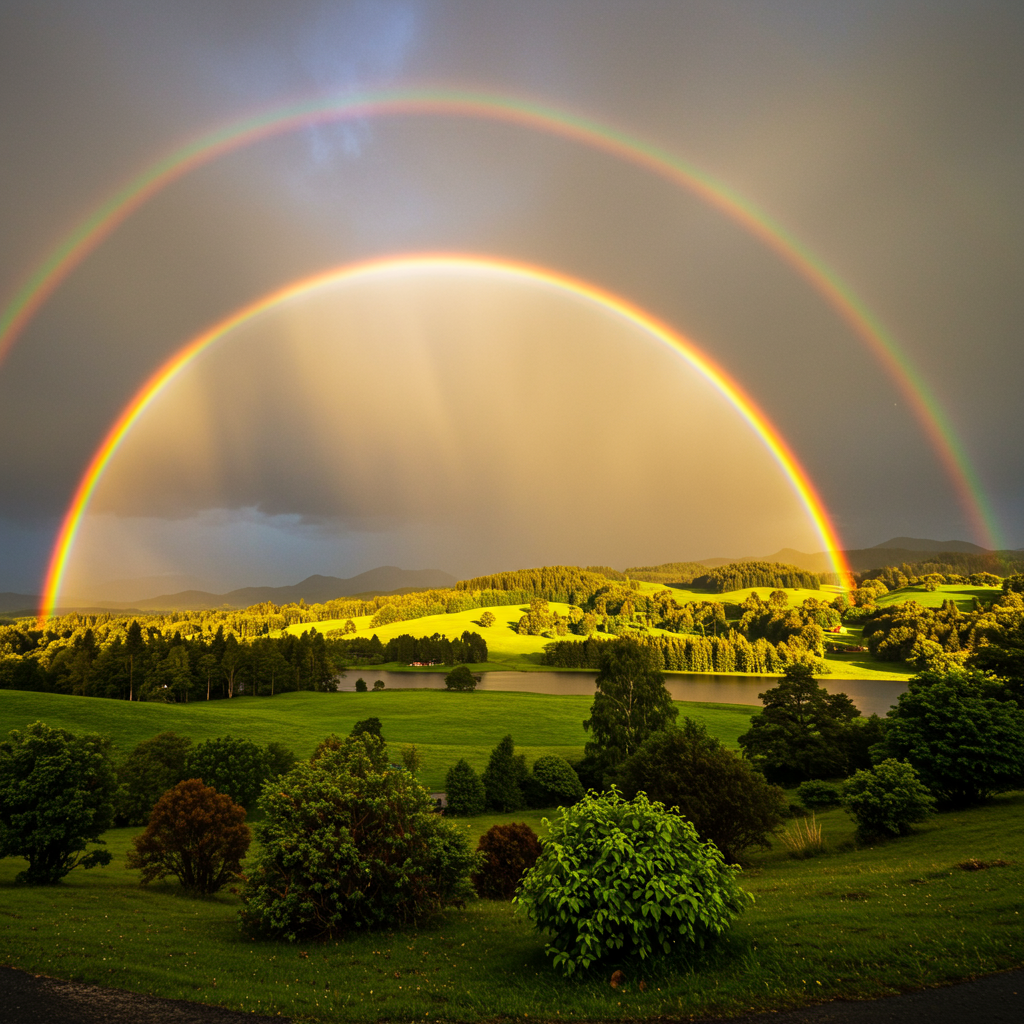
Rainbows, those ethereal arcs of color painted across the sky, have captivated humanity for millennia. From ancient myths attributing them to divine bridges to modern science dissecting their formation, rainbows hold a unique place in our collective consciousness. But how exactly do these mesmerizing displays of light and color come to be? This article delves into the fascinating science behind rainbows, exploring the interplay of sunlight, water droplets, and the physics of light that create this breathtaking natural phenomenon.
The formation of a rainbow hinges on the interaction of sunlight with airborne water droplets, typically after a rain shower. When sunlight enters a water droplet, it slows down and bends, a phenomenon known as refraction. Because different wavelengths of light – which correspond to different colors – bend at slightly different angles, the white sunlight is separated into its constituent colors. This separation becomes even more pronounced as the light reflects off the back of the water droplet and is refracted again as it exits the droplet, sending a spectrum of colors towards the observer. This process, repeated across countless droplets, creates the familiar arc of a rainbow.
The specific arrangement of colors in a rainbow, always with red on the outer edge and violet on the inner, is determined by the varying degrees of refraction. Red light, with its longer wavelength, bends the least, while violet light, with its shorter wavelength, bends the most. This consistent order gives the rainbow its characteristic pattern. Interestingly, each observer sees their own unique rainbow, formed by a different set of water droplets. This means that two people standing next to each other are technically seeing slightly different rainbows, further adding to their magical quality.
Beyond the primary rainbow, a fainter secondary rainbow can sometimes be observed above the main arc. This secondary rainbow is formed by light that undergoes two internal reflections within the water droplet before exiting. The color order in the secondary rainbow is reversed, with violet on the outside and red on the inside, and the colors appear less intense due to the double reflection. The darker band between the primary and secondary rainbows, known as Alexander’s band, results from the different angles at which light exits the water droplets after one or two reflections.
Rainbows are more than just a fleeting spectacle; they represent a beautiful demonstration of fundamental optical principles. They remind us of the intricate interplay of light and water, and the wonder that can be found in even the most commonplace natural occurrences. So, the next time you see a rainbow arching across the sky, take a moment to appreciate not only its beauty but also the fascinating science that brings it to life.